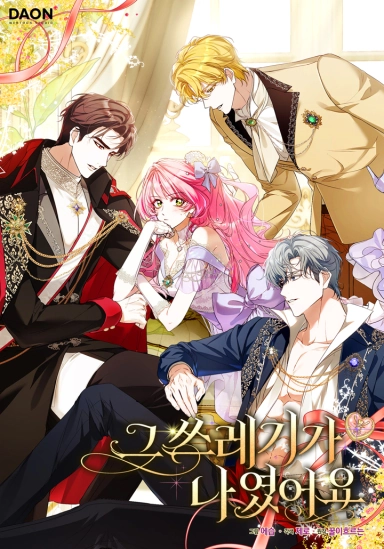
Chapter 1
Episode 1
Tulia possessed a face of rare elegance.
Her character, however, was fundamentally depraved.
In the world of stories, that made her a villainess.
She was the textbook antagonist, a girl destined to drown in a sea of her own blood regardless of the path she chose.
If there was a single detail that separated Tulia Frazier from the standard archetype, it was that she didn’t originate from the pages of a novel. She was a creation of a video game. Up until a moment ago, that was the only distinction.
Now, a new variable had been added to her miserable existence.
I have no idea why I suddenly regained consciousness inside this magnificent pile of human garbage.
In my previous life, people called me Han Ina.
My entire biography could be condensed into a single, blunt sentence.
It was a total disaster.
The true downward spiral began when my mother and stepfather passed away in rapid succession. I never imagined that my stepbrothers—men who shared my legal surname but not a drop of my blood—would approach me with such a disturbing proposition.
They wanted me to attend a marriage meeting. At the time, I was only twenty-two.
It hadn’t even been half a year since we buried our parents.
They droned on about the suitor being the only son of some corporate partner, but I tuned them out. It didn’t matter how much wealth his family possessed.
The man was seventeen years my senior and had already failed at marriage twice.
The sheer audacity of my brothers was sickening; they had run the family inheritance into the ground and were now trying to sell me off to fix their mistakes.
When I told them to marry the man themselves if he was such a catch, they slapped me.
When I pointed out that our older sister was a more appropriate age for him, they threw me out onto the street.
I managed to secure a tiny studio apartment and survived by balancing part-time shifts with my university studies and the hunt for a real career. During my rare moments of downtime, I sought refuge in a specific game.
“Why Did That Young Lady Give Bread to the Handsome Man.”
Most people just called it Bread Lady.
It was a sensation from the moment it hit the market, dominating the app store rankings for years.
The premise was simple: An illegitimate girl enters the household of a Grand Duke as a potential bride. The player must raise her stats to charm the family and secure the affection of various suitors. It was a quest for ultimate romance and social standing.
They say the classics never go out of style for a reason.
With its breathtaking artwork, intricate plot twists, and massive scale, the game maintained a fiercely loyal following. I was one of those players who had been checking in on it for years.
I often thought that if I had any disposable income, I would have just paid to unlock all the different conclusions.
Like most mobile titles, Bread Lady allowed players to bypass the grind and view every ending instantly if they were willing to open their wallets.
For someone like me, who struggled to cover monthly rent, such microtransactions were an impossible dream. I paid for my progress with time instead of cash.
Even after years of playing, the game never truly felt stale. The sheer volume of character illustrations—hundreds of them—made even the side characters a joy to look at.
Lately, my interest had been captured by a specific pink-haired antagonist.
Initially, I just figured she was another beautiful face in a game full of them. But as I delved deeper, I realized she was utterly beyond redemption.
Obsessed with her noble status, she tormented the low-born protagonist with a cruelty that was as creative as it was vile. Whenever the Grand Duke showed the heroine grandfatherly affection or a male lead confessed his love, this girl would inevitably arrive to ruin her life or attempt to end it.
I found myself wondering exactly how many ways the developers had designed for this girl to die.
Despite my long history with the game, I had just discovered a new illustration of her being impaled through the heart by a blade.
I had already seen her die by the blade of a guillotine, a chalice of hemlock, a plunge from a jagged cliff, and the wheels of a speeding carriage.
I assumed I had seen every possible demise.
Just as I was magnifying the image of her face—twisted into a truly manic expression—the screen changed.
GAME OVER.
I was baffled.
The message appeared even though I hadn’t made a move. Panicked by the sudden freeze, I gripped my phone tight, but the device was dead to my touch. It sat there, displaying those two words with an eerie, cinematic stillness.
I tried to console myself with the fact that I didn’t have to work the next day.
I planned to take the phone to a technician as soon as I woke up, but the morning sun never came for me.
My siblings somehow tracked down my hidden apartment. They burst in during the dead of night and forced me into their vehicle.
“Ina, listen to reason,” they pleaded. “The CEO’s son saw your social media. He’s obsessed with you.”
They tried to sweet-talk me.
“He thinks you’re different,” they said. “He likes that you seem so innocent compared to other girls.”
Then came the vitriol.
“You selfish brat! Do you have any idea what happens to our business deals if you blow this?”
Rain lashed against the windows as the argument reached a fever pitch inside the cramped car.
The last thing I recall is the tires losing their grip on the slick pavement. I felt my body lurch as the car spun, accompanied by the frantic screams of my siblings as they fought for control of the wheel.
Then, the world vanished into a void.
I have no idea how much time passed before I regained my senses. When I finally stood before a mirror, I couldn’t stop myself from screaming.
The reflection showed a pair of sharp, haughty eyes that betrayed her stunning features. It was the face of that psychotic villainess with the endless catalog of death scenes.
I had become Tulia Frazier.
I was well aware of the tropes in web novels—people dying only to wake up inside a fictional world or find themselves transported back to their own past.
I couldn’t help but feel cheated. If this was going to happen, why couldn’t I have just regressed to my own youth?
I ground my teeth in frustration.
If I had gone back in time, I would have dismantled my siblings’ schemes with cold, calculated precision. I would have gone back even further, weeping at my mother’s feet and begging her to stay with me instead of marrying into that family.
But there was no point in dwelling on “what ifs.”
I had to face the reality of my current situation.
The one saving grace was that Tulia’s entire life story—every memory since her birth—was now etched into my mind. It allowed me to orient myself in this bizarre new life relatively quickly.
I realized I was currently fifteen years old.
I turned my gaze to a painting mounted near the bed. It was a gift from Tulia’s father, Marquis Frazier, for her most recent birthday.
The man was stationed at a dangerous border, perpetually occupied with suppressing barbarian tribes. He sent a small painting every year, and these served as my chronological markers.
[Tulia Frazier, 15th Birthday.]
The inscription was clinical. There were no well-wishes, no expressions of fatherly love.
It was clear that the Marquis loathed his own daughter.
His resentment stemmed from the death of his wife, who had perished in an accident while attempting to run away with her first love. Following that tragedy, the Marquis abandoned the family estate for the frontier. He hadn’t bothered to look Tulia in the eye for years.
The annual gift of a cheap painting was the extent of his parental involvement.
To make matters worse, he barely provided enough funds for her basic needs.
That explained why Tulia had lived in such relative squalor before she eventually turned to a life of malice. Her lineage was impeccable—her grandfather was the sole Grand Duke of the Empire—yet she lived like a commoner.
Technically, she was the granddaughter of a titan, but she received none of the perks. All the warmth and luxury were earmarked for Coriko, the game’s protagonist.
I understood why the story was structured this way; the player needed a reason to seek the “good” endings.
The protagonist’s luck was a narrative necessity. Due to religious maneuvering, Coriko was brought into the household as a potential bride and, depending on the player’s moves, could easily charm the entire family.
Even the formidable Grand Duke, a man who terrified his own children, turned into a doting grandfather whenever Coriko was around.
The only people who continued to treat Coriko with disdain because of her birth were a few insignificant nobles and, of course, Tulia.
Tulia’s reputation in high society was already scorched.
She was the type of person who would rather destroy something than see someone else enjoy it. Her jealousy toward the pampered Coriko was a slow-burning fuse.
I called her “Crazy Tulia” in my head before remembering that I was now inhabiting her body.
In the game, Tulia’s constant harassment of the heroine always led to a brutal reckoning. Whether she was executed by the male leads or the Grand Duke’s men, it was just another “boss defeated” moment for the player.
I remembered one specific ending where Coriko, driven past her breaking point, personally ended Tulia with an axe. At the time, I found it incredibly cathartic.
Now, that memory was terrifying.
I refused to accept that a gruesome death was my only option.
Looking around the room at the aged, modest furniture, I realized I had arrived before Tulia had fully committed to her villainous path. There was still time.
The original Tulia was a noble to her marrow; she couldn’t handle the lack of luxury and turned to darkness out of spite. I was built differently.
Since my mother’s remarriage, I had been an island. I knew how to survive on nothing.
I never felt like I truly belonged at that family’s dinner table. My mother and stepfather weren’t cruel, but they never seemed to notice when I skipped meals or stayed out late under the guise of studying.
Not even once.
I could live on convenience store food and cheap bread indefinitely if I had to. I had survived my previous life through sheer grit, earning my way into a top-tier university through desperate study.
I had been told I was a success.
If I could handle that, I could handle a meager allowance in a drafty mansion.
“Actually, I take it back. This is unbearable.”
The following morning, as the sun barely touched the horizon, I buried my face in my hands, overwhelmed by the sheer hopelessness of it all.
